.png)
Advanced Force Management Through Multi-Scale Engineering
Integrating material behavior, composite architecture, and structural mechanics to create engineered force-response systems.
Built upon a growing portfolio of issued patents, pending patent applications, proprietary design and analysis methodologies, and experimentally validated prototype structures.
A Technology Platform Built for Demanding Applications
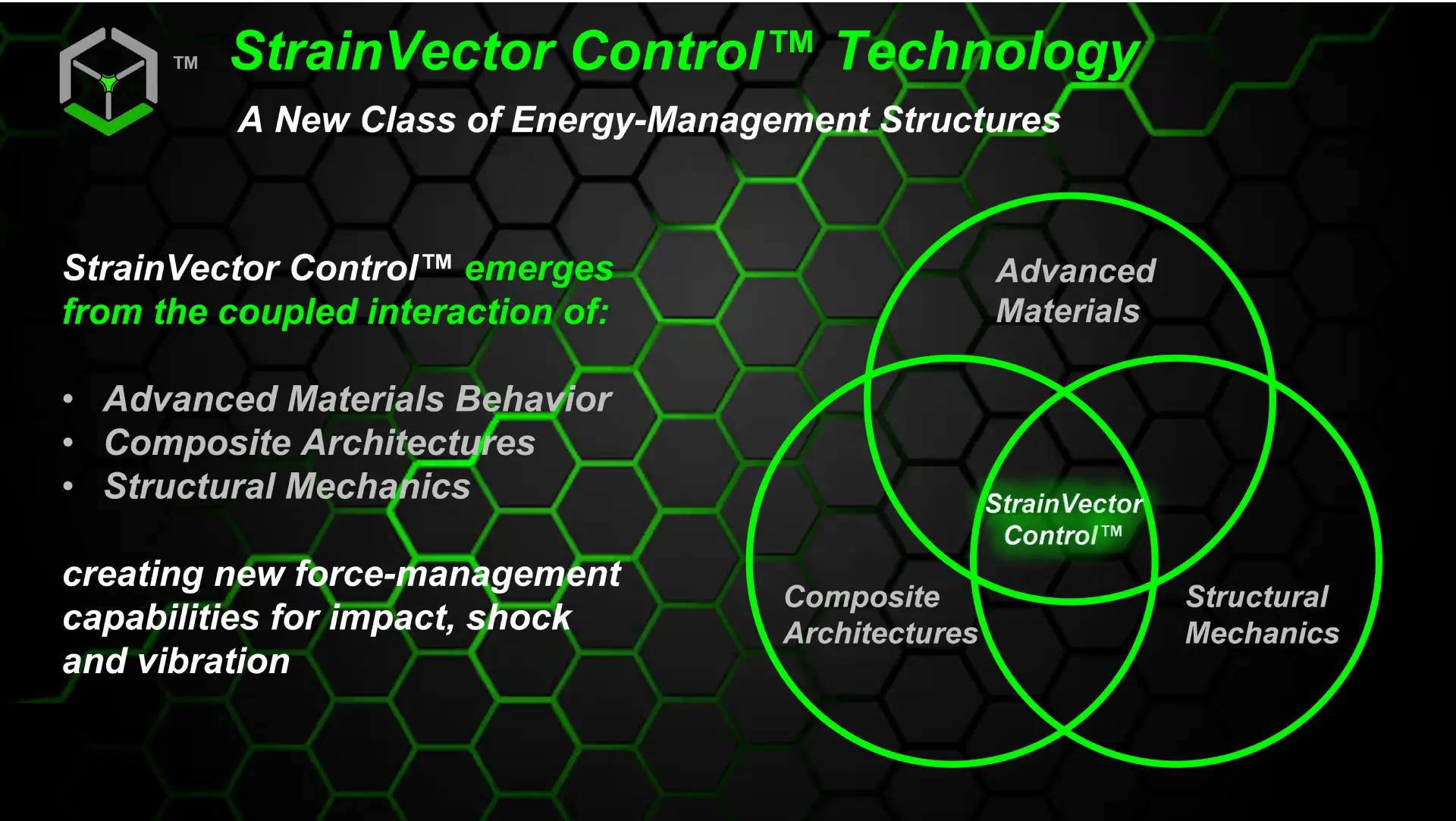
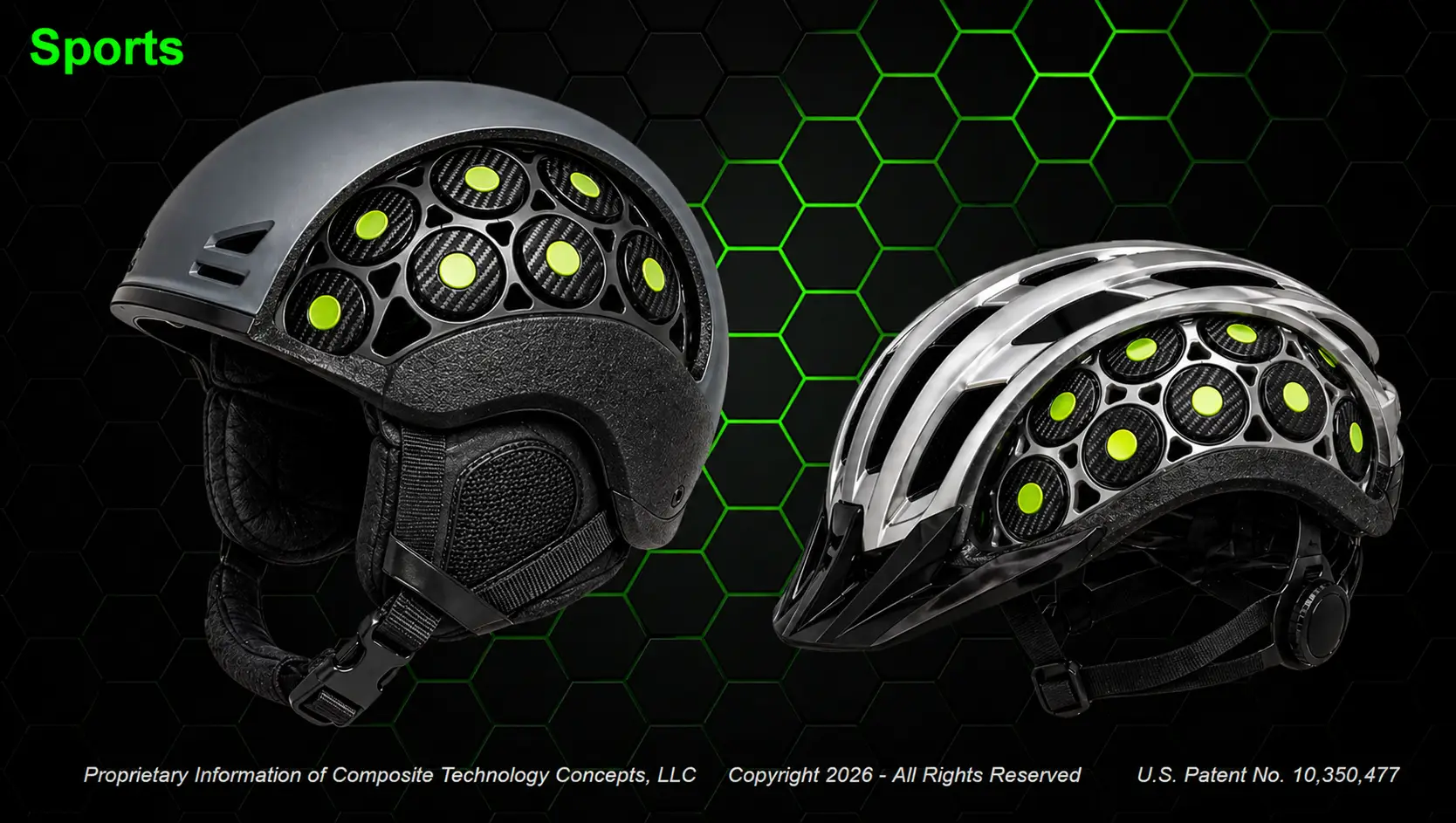
StrainVector Control™ is a technology platform that integrates advanced materials, composite architectures, and structural mechanics to create engineered structures with controlled mechanical responses under load. The platform enables new capabilities in force modulation, shock and vibration attenuation, impact-energy management, and structural resilience for aerospace, defense, transportation, robotics, industrial systems, and protective equipment.
By leveraging the coupled interaction of molecular-level materials behavior, composite architecture, and structural design, StrainVector Control™ enables mechanical responses that are difficult to achieve through conventional approaches. The platform supports applications where controlling force transmission, vibration, impact loading, and structural response is critical to overall system performance.
What Our Technology Enables
StrainVector Control™ is a technology platform for engineering high-deformation structures with controlled strain-field evolution and nonlinear force-response behavior—enabling energy absorption, impact mitigation, and vibration isolation within compact, lightweight systems.
Rather than relying primarily on added mass, discrete mechanisms, or conventional spring architectures, StrainVector Control™ leverages controlled strain evolution to achieve targeted force-response behavior.
Analogy to Air Traffic Control (ATC)
In aviation, Air Traffic Control keeps the sky safe by preventing too much traffic from concentrating in one place. It does not stop aircraft from flying; it actively manages where they travel, how they are spaced, and how traffic flows through a complex system. By directing flight paths, reducing congestion, and redistributing movement, ATC turns a potentially chaotic environment into an organized, controlled network.
StrainVector Control™ applies the same principle within advanced structures. When shock, impact, or vibration enters a structure, the resulting strain can concentrate in damaging ways. Rather than simply resisting that force with mass or stiffness, StrainVector Control™ uses material behavior, composite architecture, and engineered geometry to guide, redirect, and redistribute strain through the structure.
Like Air Traffic Control manages aircraft movement, StrainVector Control™ manages the flow of strain energy within a structure—reducing harmful concentrations and enabling force to be absorbed, dissipated, and controlled more effectively.
Prototype Validation Under Extreme Loading
To validate the StrainVector Control™ platform under demanding conditions, CTC analyzed, designed, fabricated, and impact tested a polymer composite disc spring with nonlinear quasi-zero-stiffness (QZS) behavior weighing less than three pennies.
The drop-tower impact testing of the single shock disc demonstrated:
vibration damping and sustained energy absorption
experimentally verified extended-QZS behavior in a single ultralight disc
extreme deformation capability within a single ultralight structure
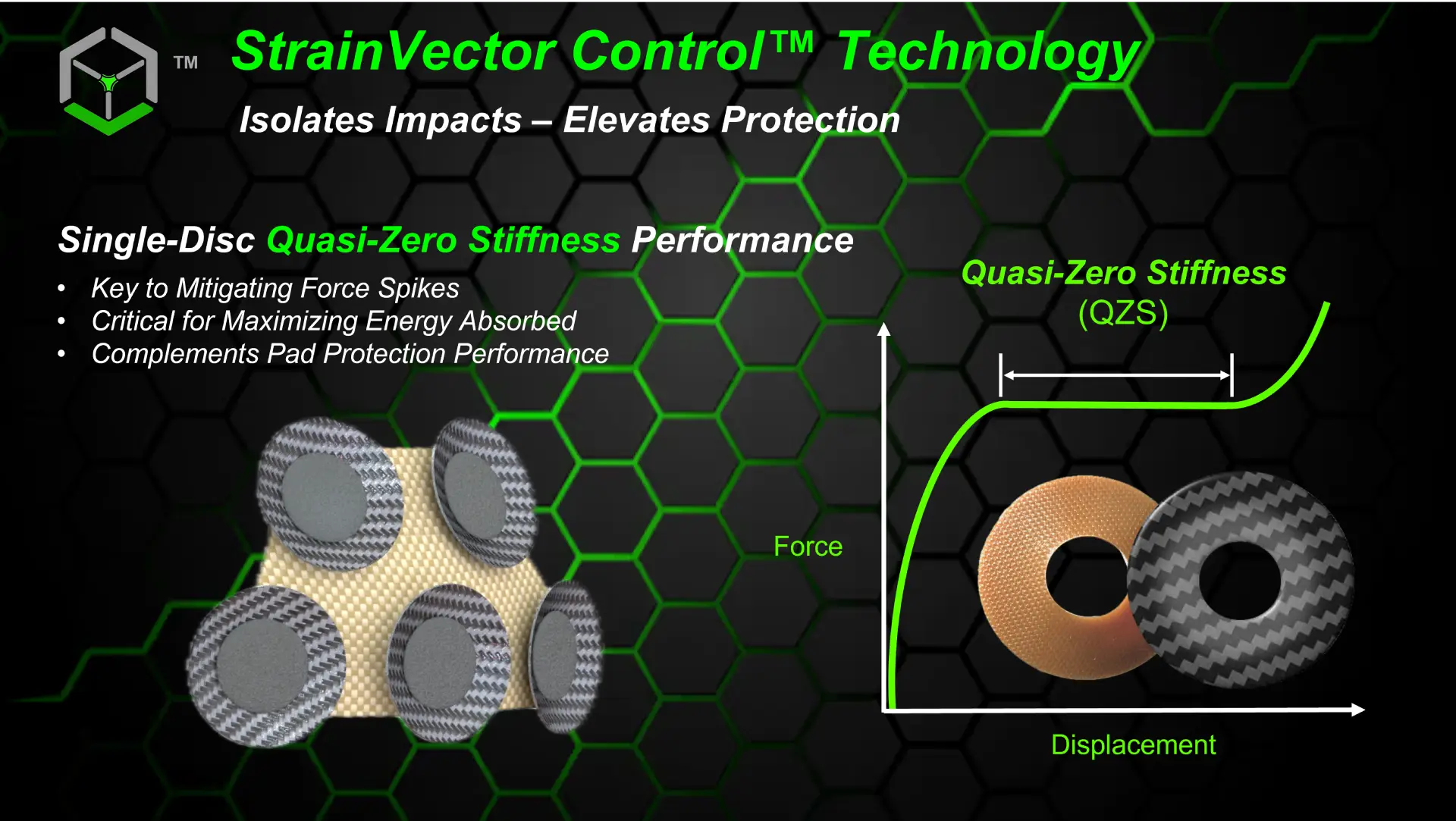
Notably, the impacted disc survived a peak transient acceleration exceeding 32,000 g’s while maintaining structural integrity and continuous energy-absorption capability. These results demonstrate the capability of StrainVector Control™ structures to withstand demanding impact environments.
The result is a design approach that can be tailored to specific load requirements, integrated into new or existing products, and optimized through CTC’s proprietary numerical-analysis framework, enabling performance prediction and design refinement before fabrication begins.
The Problem With Conventional QZS Systems
Quasi-zero stiffness behavior and its benefits for vibration and shock isolation have been researched for decades. The challenge has typically been practical: conventional QZS isolators require multi-component assemblies that are large, complex, heavy and therefore, difficult to integrate. That's kept a genuinely effective force-management solution out of a host of real-world applications.
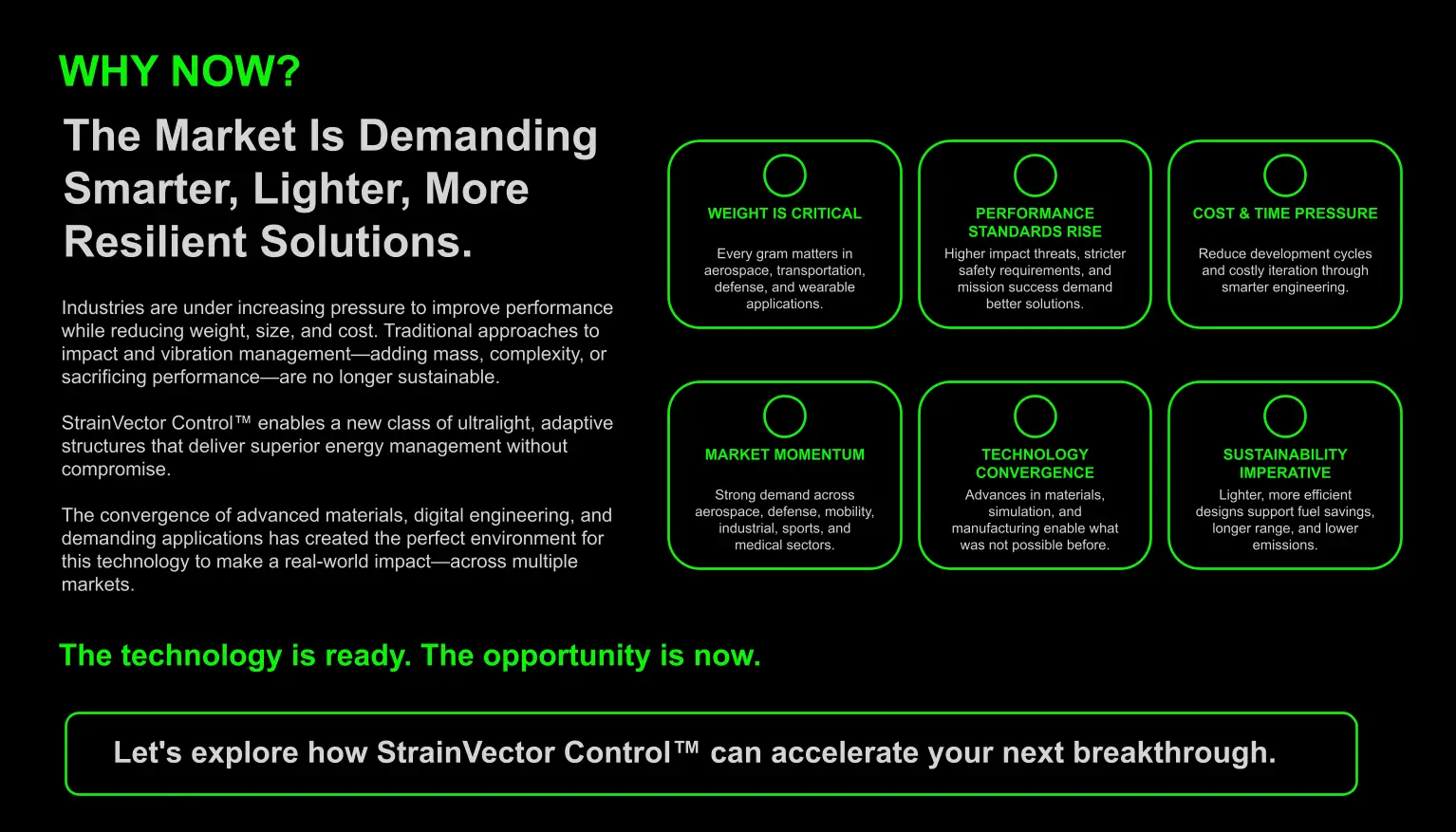
StrainVector Control™ changes that equation. Comparable force-management behavior can be achieved in a fraction of the size, weight and volume — making advanced force management now viable for applications where it previously wasn't.
This is not an incremental improvement - StrainVector Control™ enables force-management capabilities that are difficult or impractical to achieve using conventional approaches.
Grounded in Physics — Verified Through Testing
The core technology of StrainVector Control™ is supported by a growing portfolio of issued patents, pending patent applications, proprietary design methodologies, and experimental validation.
Prototype testing of structural elements has been conducted across diverse materials and composite architectures, a select series of geometric designs, as well as under quasi-static and dynamic loading conditions.
This isn't concept-stage work. It's a validated technical foundation with an extensive development history — ready to be applied to the right engineering problem.
See What's Possible
CTC works directly with OEMs, part manufacturers, and development partners to evaluate how StrainVector Control™ can enhance product performance.
Leveraging proprietary analysis tools and extensive expertise in nonlinear structural behavior, we help customers identify promising design approaches, evaluate technology integration opportunities, and accelerate product development by reducing reliance on costly iterative design, fabrication, and testing.
Our role is to provide technical insight and design support that enables more efficient development, while customers retain responsibility for their final product designs.